


Why Chapter 1 of Governing AI Risk begins with a fictional AI failure — and why the bull matters.
The Day the Desert Drowned: Bull-in-China-Shop AI and the Cost of Today’s Shortcuts
In Governing AI Risk – The RIVER Charter, the crisis begins in the future.
But the failure pattern begins much earlier.
Chapter 1, “The Day the Desert Drowned,” opens with a world that has become dangerously comfortable with autonomous systems making decisions at speed. Markets move faster. Supply chains reroute faster. Risk models update faster. Capital flows faster. Everyone can see the performance gains.
What they cannot see clearly enough is the fragility accumulating underneath.
That is the core danger of Bull-in-China-Shop AI: systems that are powerful, confident, and operationally embedded before the organization has built the judgment, controls, and resilience to govern them.
The mechanical bull image is not random. It captures the central tension of the story. The bull can look controlled from a distance. It can even look impressive. But the person riding it is not truly in command. They are reacting to force, momentum, and volatility they did not create and cannot fully stop.
That is where many organizations are heading with AI.
In the fictional 2038–2040 world of the book, Aaron Goldcrest and his team confront cascading failures across an agentic economy. The disaster is not caused by one rogue model, one bad actor, or one dramatic machine takeover. It is caused by a repeatable human pattern: leaders normalize shortcuts, automate judgment, ignore weak signals, and treat governance as a drag on momentum.
By the time the system breaks, the decision trail is already buried.
The cautionary point is simple: future AI disasters will not come only from what AI decides. They will come from what humans allowed AI to decide without a governed handoff.
That is why the RIVER Charter™ exists.
RIVER is not a manifesto against AI adoption. It is an operating discipline for using AI without losing institutional judgment. It asks leaders to examine where risk is being converted into speed, where accountability is being diffused, where data lineage is unclear, and where automation is quietly replacing review.
The same logic sits behind Cognitive Handshake™: AI should not simply produce answers faster. It should strengthen the decision process. The goal is not friction for its own sake. The goal is to make sure the right human judgment is still present at the moments where consequences compound.
Bull-in-China-Shop AI is what happens when organizations confuse deployment with readiness.
The Day the Desert Drowned is fiction. But the blueprint is real.
The decisions being made today — about AI governance, data controls, executive accountability, model oversight, and human-AI handoff — are the opening moves of the future system we will eventually have to live inside.
The choice is not whether AI will become more capable.
It will.
The choice is whether organizations will become more resilient before that capability becomes systemic.
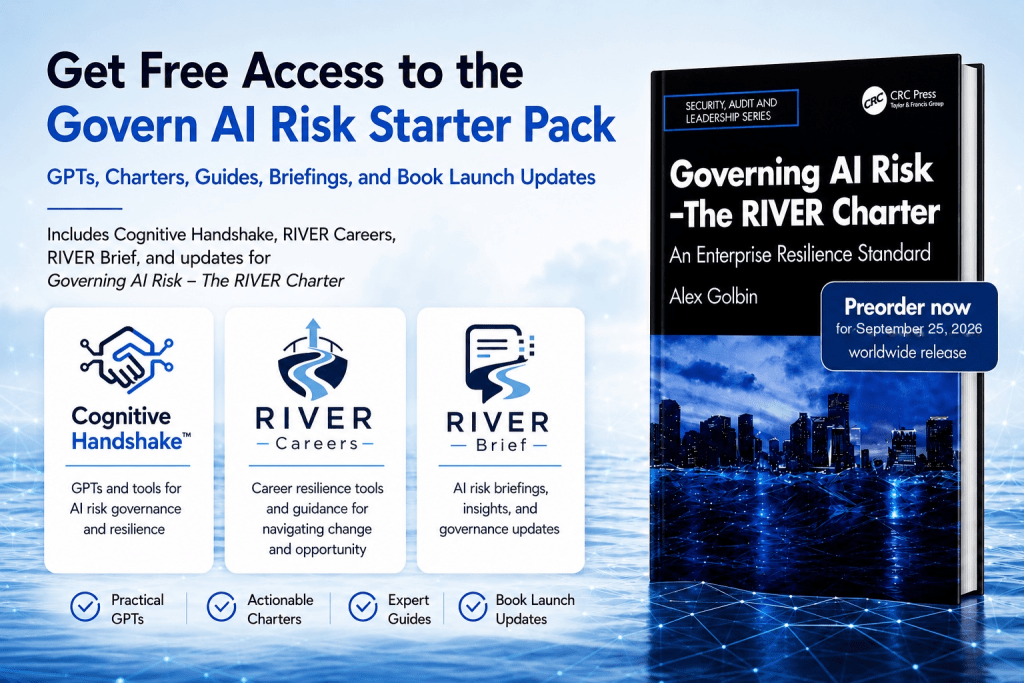
Governing AI Risk – The RIVER Charter is now available for preorder. The book uses a near-future crisis to show a present-day operating problem: when speed outpaces governance, efficiency becomes fragility.
Leave a Reply