Issue 2 of Governing AI Risk: RIVER Brief
A practical RIVER Career Resilience check — available as a free GPT in ChatGPT — to assess your role, sharpen your positioning, and plan your next move.
Enhanced Edition Note
This website version adds a field-manual layer to the LinkedIn edition: how the E-Shaped Professional model from Governing AI Risk — The RIVER Charter fits underneath the assessment, and why this is different from ordinary resume polish or generic career advice.
Why it matters: LinkedIn introduces the career question. This version adds the practical layer how the broader RIVER framework turns AI-era career anxiety into a structured readiness check.
A colleague once shared a line from one of his coaches that stayed with me:
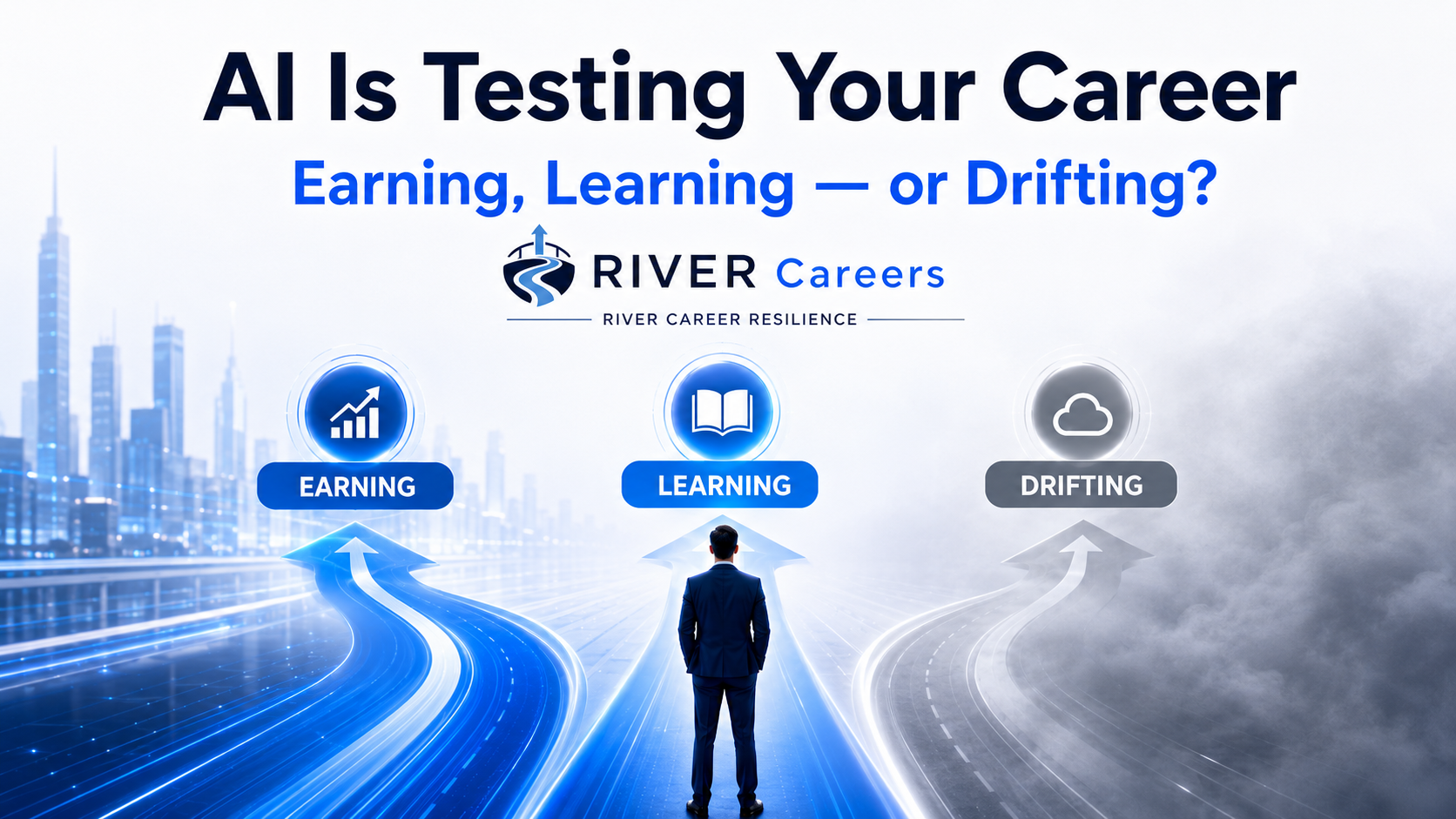
You are either earning or learning — ideally both.
At the time, it sounded like good career advice.
In the AI era, it feels more like a resilience test.
A role can still pay well. A title can still look strong. A calendar can still be full. A LinkedIn profile can still look polished.
And yet the harder question may remain unanswered:
Is your career actually compounding?
The RIVER Career Resilience GPT is available now as a free GPT in ChatGPT.
You can try it free with your LinkedIn profile, resume, or a real career question.
That question feels more important now because the public conversation around AI is getting louder, sharper, and more emotional. Some people are excited. Some are angry. Some are exhausted by the hype. Some are worried, reasonably, about what AI means for their work, their children, and their future.
I am not writing this to cheerlead AI.
I am not writing this to dismiss the anxiety either.
My contribution is more practical: if AI is going to reshape work, then professionals need better ways to prepare — not just react.
The question is no longer only:
Will AI take my job?
That question is understandable, but too blunt.
A better question is:
What part of my value gets stronger as AI gets better?
And another:
What part of my role looks safe today but may be quietly accumulating career Risk Debt?
Busy is not the same as resilient
Many professionals are busy. That is not the same as being future-ready.
Busy can mean you are trusted.
Busy can mean you are needed.
Busy can also mean you are spending your best energy on work that is becoming easier to automate, compress, or move elsewhere.
A normal resume review might tell you your profile is polished.
What a Standard Resume Review Might Miss
A standard resume review might say:
“Your headline is strong, but your bullets need more metrics.”
That may be true.
A RIVER Career read asks a different question:
“Does your visible profile prove that your value is becoming more durable as AI changes the work?”
For example, a profile might show strong execution but under-signal exploration, hybrid cognition, or data-capital judgment. In that case, the next move may not be another credential or a prettier headline.
It may be visible proof that you can use AI, evidence, and judgment together to improve decisions.
Why it matters: Surface polish can make a profile look better. Career resilience asks whether the profile, role, and next move are building durable future value.
A RIVER Career read asks a harder question:
Is your strongest visible credential still compounding — or is it the part of your value AI may compress first?
That distinction matters.
A person may have a strong current role but weak future signal.
Another may have a messy-looking path but stronger underlying resilience because they are learning across domains, making better decisions with AI, building visible proof, and adapting faster than their title suggests.
That is why I built Cognitive Handshake — RIVER Career Resilience as a practical front door into this question.
It is not a job-loss prediction tool.
It is not a personality test.
It is not a generic resume optimizer.
It is a structured way to pressure-test your current role, future trajectory, visible strengths, hidden liabilities, positioning, and next move in the AI era.
The RIVER Career GPT is live now in ChatGPT
You can access it as a GPT in ChatGPT or from the RIVER Career page on RIVER Career page. It is free to use.
The simplest way to start is practical:
- Paste your LinkedIn profile, resume, or both.
- Add one or two sentences on your goal.
- Include a current or target job description if role fit matters.
Then ask for the first thing you need: a baseline read, a best-move assessment, positioning help, market calibration, or comparison across options.
The point is not to produce a pretty rewrite first.
The point is to improve the judgment behind the rewrite.

Five things you can use it for
First, you can assess your current role resilience and AI future-readiness.
That means asking whether your current work is building durable value, or whether it is leaving you exposed to a future you are not preparing for.
Second, you can test whether your current role is still compounding.
Are you earning and learning? Are you building skills, judgment, evidence, and adaptability that will matter next? Or are you mostly maintaining the old version of your professional value?
Third, you can sharpen your LinkedIn profile or resume.
But the goal is not surface polish. The goal is to make your positioning match where your value is actually going.
Fourth, you can calibrate against a target role or market direction.
This is useful when you are not sure whether your profile fits the roles you think you want, or whether the market is signaling a better direction.
Fifth, you can compare concrete options.
Stay or move. Deepen or reposition. Target one role family or another. Accept an offer or keep searching. The point is to compare choices through a longer-term resilience lens, not only through short-term title or compensation.
The deeper talent question
In my upcoming book, Governing AI Risk — The RIVER Charter, I introduce the E-Shaped Professional as a deeper talent pattern for the AI era.
RIVER Career Resilience uses that idea underneath the assessment.
The goal is not to label people. The goal is to ask whether someone’s expertise, judgment, learning posture, execution, and ethical grounding are becoming more valuable as work changes.
That is why this is bigger than a resume exercise.
A resume can show what you have done.
A stronger career-readiness assessment asks what your work is preparing you to become.
The E-Shaped Professional
The five E’s are:
Expertise — the depth you bring to a domain.
Experience — the operating judgment built through real work.
Exploration — the ability to learn across new tools, domains, and uncertainty.
Execution — the ability to turn insight into visible outcomes.
Ethics — the judgment to use power, data, and AI responsibly.
A traditional career read often overweights the first two: expertise and experience.
The AI era raises the value of the full shape.
The stronger question is not only, “What have I done?” It is also, “What am I becoming more capable of doing as the work changes?”
Why it matters: RIVER Career Resilience uses the E-Shaped model underneath the assessment. The goal is not to label people. The goal is to ask whether a professional’s value is still compounding as AI changes the work around them.
My practical challenge
Ask yourself:
Am I earning?
Am I learning?
Am I doing both?
Or am I drifting inside a role that still looks good from the outside?
That is not meant as a criticism. It is meant as a useful diagnostic.
For many professionals, the next move may not be a dramatic pivot. It may be sharper positioning. A better internal stretch. A more visible AI-use case. A clearer role target. A stronger story about how judgment, data, risk, operations, governance, and execution come together in your work.
The future may not belong only to the people with the safest-looking jobs.
It may belong to the people who can show that their value keeps compounding.
The RIVER Career Resilience GPT is live and you can learn more at the RIVER Career page. Start with your LinkedIn profile, resume, or a real career question — and ask whether your role is helping you earn, learn, and compound.