Aaron Golbin on AI-use-case fit, distribution, and the risk discipline founders cannot skip.
The uncomfortable part: AI can make a startup faster and less defensible at the same time.
Expanded Website Edition
This website version adds the decision layer behind the LinkedIn article. This expanded version adds:
-> the book connection to Governing AI Risk — The RIVER Charter
-> the Cognitive Handshake read behind the piece
-> the evidence test for when AI becomes a real advantage
-> the governance question for boards, executives, audit, security, privacy, and risk leaders
Why it matters: Where is AI making the company more defensible — and where is it only making it faster?
The same tools that help a founder ship faster can also make the product easier to copy.
Two startups can use the same model.
One adds AI because investors expect it. The other finds a customer problem where AI changes behavior: users return more often, the sales cycle shortens, support tickets drop, or customers would complain if the feature disappeared.
Only one has an advantage.
Aaron has seen this pattern in founder conversations.
The AI feature gets attention first. The demo works. The pitch sounds current. The team is moving faster.
But diligence quickly shifts to harder questions.
Who needs it? How will it reach the market? What changes in the customer’s behavior? What risk does it introduce? What still makes the company defensible if the underlying model improves for everyone?
That is where “we use AI” stops being an answer.
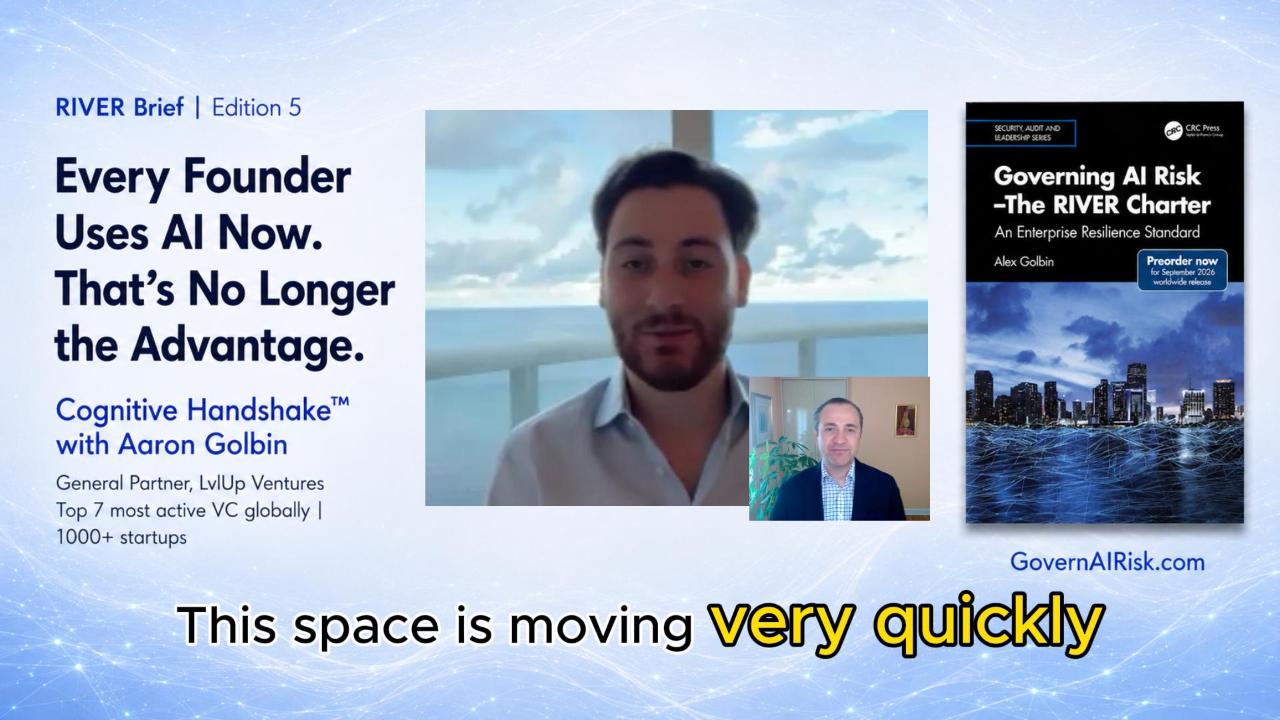
In this Cognitive Handshake with Aaron Golbin, General Partner at LvlUp Ventures, we bring a VC lens to a simple founder question:
When does AI make a startup better — not just faster?
The test is simple: does AI change customer behavior, strengthen distribution, improve judgment, or create defensibility that survives when the feature becomes easier to copy?
1. AI use cases need product-market fit too
One of Aaron’s strongest points is that founders should not treat AI use cases as automatic value.
A product may use AI. A workflow may include AI. A demo may look impressive. But if the customer does not actually need that use case, it becomes decoration.
Founders already understand product-market fit. The next layer is AI-use-case fit.
Does the AI capability solve a real customer problem? Does it improve the product in a way users actually feel? Does it create a repeatable advantage, or just make the demo more exciting?
A simple test: if customers would not choose it, pay for it, return because of it, or complain if it disappeared, it is probably not an advantage yet.
The founder mistake is assuming that adding AI automatically increases value. The better question is whether the AI use case has real pull.
2. Distribution still matters in the AI era
Aaron’s distribution point is blunt and practical:
A good product with strong distribution can win. A great product with no distribution usually cannot.
That matters even more in the AI era.
As AI features become easier to build, the advantage shifts toward founders who can learn faster, reach customers faster, and create trust faster. Distribution is not separate from product strategy. It is part of whether the product survives long enough to learn.
AI can accelerate work. It cannot magically create customer trust, market access, or founder credibility.
Founders still need traction. They still need customer signal. They still need a path to reach the market before the market moves on.
For investors, each of these questions is also a diligence test.
3. AI cannot be an afterthought
The weakest AI strategy is treating AI as a feature layer added after the real company strategy has already been set.
Aaron pushes founders to think more broadly: AI should shape product, roadmap, go-to-market, marketing, customer discovery, fundraising, internal operations, and team design.
That does not mean every startup has to become an “AI company” in the hype-cycle sense.
It means every founder needs to ask:
Where is AI actually changing how this company learns, builds, decides, sells, and manages risk?
If the answer is only “we use ChatGPT,” that is not a strategy. That is the new baseline.
4. Risk management is founder survival
The strongest close from Aaron is also the simplest:
Risk management. Risk management. Risk management.
That may sound obvious. It is not.
In a startup, risk often hides inside speed. A founder moves fast, ships fast, hires fast, sells fast, raises fast. AI can make that even faster.
But AI can also scale the mistake.
A small data shortcut can become a privacy issue. A weak product assumption can become an automated customer experience. A missing owner can become a risk no one is monitoring.
That is why risk management is not just an enterprise compliance function. For founders, it is survival discipline.
Risk management should touch product, AI, technology, team, operations, partnerships, and strategy. Not because founders should become slower, but because better judgment compounds.
The Cognitive Handshake Lens
I also ran this issue through a Cognitive Handshake review — not to summarize the conversation, but to ask what decision it should change.
The useful challenge was this:
AI only becomes an advantage if it changes what leaders can test, defend, monitor, or govern.
That means the question is not simply whether a founder is using AI, or whether the demo looks better, or whether the team is moving faster.
The leadership question is whether the AI use case changes the evidence available before action:
-> Can customers feel the difference?
-> Can the company distribute it?
-> Can the team explain what risk it creates?
-> Can leaders name who owns it?
-> Can the business still defend itself if the feature becomes easy to copy?
Why it matters: That sharpened the issue from:
“Are we using AI?”
to:
“What evidence shows this AI use case creates durable advantage without accumulating risk debt faster than we can govern it?”
The boardroom version of the founder question
For boards, executives, audit, security, privacy, and risk leaders, the question is sharper:
Where is AI creating measurable advantage — and where is it quietly accumulating risk debt?
Every significant AI use case needs more than a demo. It needs an owner, a customer or operating outcome, a data boundary, a control expectation, and a monitoring rhythm.
Otherwise, AI can improve speed while weakening judgment.
That is one of the tensions behind my upcoming book, Governing AI Risk — The RIVER Charter.
AI can make a startup faster, stronger, and more capable. But without the right operating discipline, it can also become a functional bull in a china shop: productive, impressive, and breaking things the company has not learned to see yet.
The point is not to slow founders down. It is to help them build without letting risk debt compound faster than judgment.
The AI Advantage Test
If the model gets cheaper, the tools get better, and the feature becomes easier to copy, what still makes the company stronger?
Before calling AI an advantage, ask five questions:
- Use-case fit: Would customers choose it, pay for it, return because of it, or complain if it disappeared?
- Distribution: Can the product reach the market before the market moves on?
- Integration: Is AI shaping product, GTM, operations, and strategy — or just sitting in the pitch deck?
- Risk discipline: Are risks being managed before AI scales them?
- Defensibility: If OpenAI, Anthropic, Google, or another platform releases your core AI feature for free tomorrow, what is your actual distribution and trust advantage?
Every founder uses AI now.
That is no longer the advantage.
The advantage is knowing where AI actually makes the startup better.
From Aaron Golbin to Aaron Goldcrest
This conversation is also personal.
Aaron Golbin is my son, and some of our father-son conversations helped shape how I think about founder judgment, AI risk, and the future world behind Governing AI Risk — The RIVER Charter.
Readers of the book will meet Aaron Goldcrest, a fictional character carrying some of these questions into a future where AI speed, risk debt, and human judgment collide.
Aaron Goldcrest is not a transcript of Aaron Golbin. He is a narrative echo of a deeper question:
How do we build at AI speed without letting risk debt compound faster than judgment?
That question matters because AI can make a startup faster, stronger, and more capable before it becomes wiser.
Without operating discipline, an AI startup can become a functional bull in a china shop:
productive, impressive, and breaking things it has not learned to see yet.
Why it matters: The point is not to slow founders down. It is to help them build advantage that can survive speed.
Try the Cognitive Handshake Read Yourself
You can use this prompt on any article, interview, memo, report, or argument you want to pressure-test.
Try it here in ChatGPT: Cognitive Handshake GPT
Learn more: Cognitive Handshake
Initial Prompt:
CH: COUNCIL — Review the article, interview, memo, report, or argument below.
Treat it as input for leadership judgment, not just content.
Identify:
1. The decision this piece should affect.
2. The strongest idea.
3. The weakest assumption.
4. The missing question.
5. What the piece demonstrates, implies, and speculates.
6. The practical action test: what should a reader be able to ask, decide, test, escalate, or monitor differently after reading?
7. One discussion question this piece should open for readers.
Then score the piece:
A. Cognitive Handshake Decision Score, 1–10:
How well does the piece improve judgment before action?
B. Made-to-Stick Score, 1–10:
Assess the piece using Chip Heath and Dan Heath’s Made to Stick SUCCESs framework:
– Simple: Is the core idea clear and compact?
– Unexpected: Does it create useful tension, surprise, or curiosity?
– Concrete: Does it make the idea tangible through examples, images, scenarios, or specific language?
– Credible: Does it earn trust through evidence, authority, logic, or lived experience?
– Emotional: Does the reader feel why the idea matters?
– Stories: Does narrative, scenario, or sequence help the idea travel?
C. Actionability Score, 1–10:
Does the piece change what a leader would ask, decide, test, escalate, or monitor?
End with:
– A one-paragraph Decision Receipt.
– One recommended improvement.
– One sharper question for decision-makers.
– One discussion question for readers.
Follow-up Prompt:
CH: COUNCIL REFRESH — Push harder on the missing question.
Make it sharper for boards, executives, audit leaders, security leaders, privacy leaders, and risk managers.
Separate what the piece demonstrates from what it implies or speculates.
Why it matters: Cognitive Handshake is designed to move from faster answers to better judgment before action. The prompt gives readers a way to test another article for decision quality.