A short reading on Risk Debt — and why speed-over-validation choices come due
My new book is finally here.
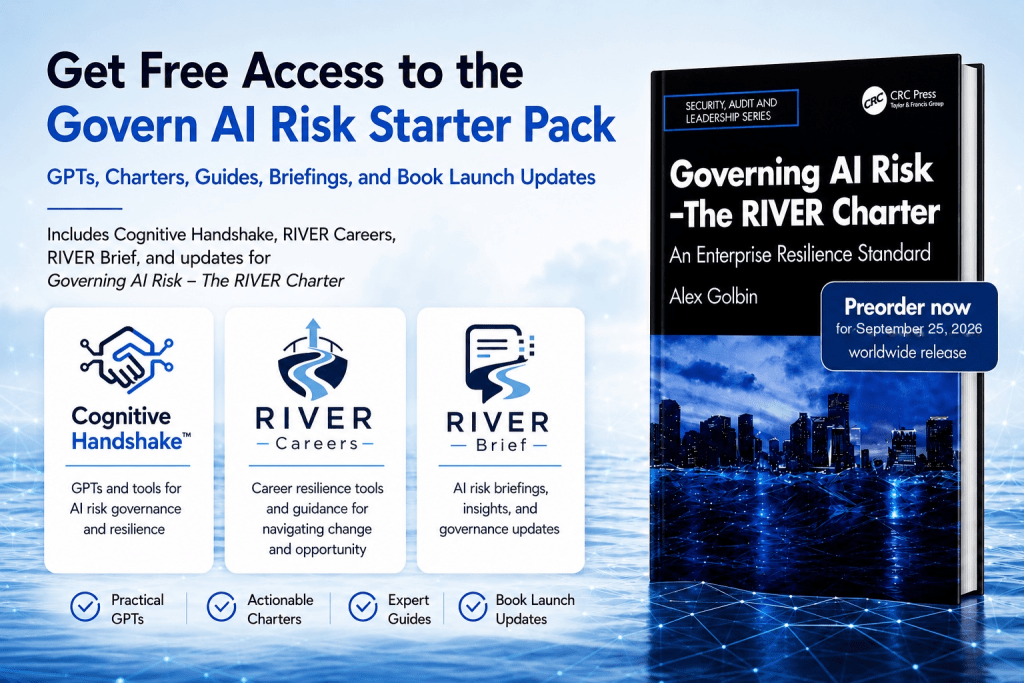
Governing AI Risk — The RIVER Charter: An Enterprise Resilience Standard is now available worldwide. Rather than give you another description of the book, I wanted to do something simpler: open it and let you experience a small piece of it.
The passage comes from Chapter 3. The scene is simple: a team is under pressure to move faster, a safety-validation loop is disabled for a demo, and the logic is familiar — ship now, fix later.
Then comes the line: “The market always collects.”
That sentence captures one of the central ideas of the book: Risk Debt.
“The market always collects.”
WHAT RISK DEBT LOOKS LIKE BEFORE IT LOOKS LIKE RISK
Risk Debt is the compounding liability created by speed-over-validation choices. It builds when organizations make decisions that are individually explainable, locally rational, and easy to postpone fixing — but increasingly dangerous when they accumulate.
A temporary workaround becomes permanent. A known data-quality problem is accepted because the next release is more urgent. An AI pilot begins operating at a scale its original controls were never designed to support. A legacy dependency is wrapped in a modern interface and stops looking old. A third-party or agentic dependency becomes critical before anyone is quite sure who owns the failure mode.
None of those decisions necessarily creates a crisis on its own.
The danger comes when the organization keeps adding speed, automation, scale and dependency on top of unresolved choices. What looked like efficiency becomes fragility — and the accumulated debt is often discovered only when multiple risks converge.
THE PROBLEM IS NOT “MOVING FAST”
I am not arguing that enterprises should slow AI adoption simply because AI introduces risk.
The opposite problem is just as real: organizations that move too slowly can lose learning velocity, competitiveness and the institutional capability needed to use AI responsibly.
The leadership challenge is therefore not speed versus governance.
It is governed speed: moving fast enough to create value while preserving enough visibility, validation, accountability and resilience to understand what the enterprise is accumulating underneath that speed.
That tension sits at the center of Governing AI Risk.
WHY I WROTE IT AS A STORY
I did not want to write another AI-governance book that asked leaders to memorize a framework before they could feel the problem.
So the book moves on two coordinated rails.
· The first is a near-future business thriller set in the 2038–2040 agentic economy, where apparently reasonable decisions made over years compound into cascading failures.
· The second is a present-day operating playbook that brings those fictional failures back to decisions leaders are making now.
The story carries the stakes. The field manual carries the response.
I wanted readers to experience why shortcuts were taken, why they looked rational in the moment, how they became embedded, and what happened when the organization finally needed controls that were no longer there.
THE FIELD MANUAL BEHIND THE FICTION
The story is only half of the book. The other half is designed to be used.
· RIVER Charter™ —a resilience framework for resolving converged risk, integrating human–AI judgment, validating Risk Debt, elevating data governance and reinforcing systems so they learn under stress.
· Cognitive Handshake™ —an auditable approach for consequential human–AI decisions that keeps human judgment load-bearing.
· All-Entity Risk Management (AERM™) —a way to look beyond traditional third-party risk toward the wider ecosystem of vendors, platforms, agents, models and other dependencies.
· DataCapital Protocol™ —a model for treating data lineage, provenance and consent with the rigor expected of a strategic enterprise asset.
· Strategic Debriefs, checklists and implementation tools —including practical material intended to help boards and operating teams move from concept to action.
My objective was not to leave the reader with a generic conclusion that “AI is risky.” It was to help answer a much harder question:
How do we capture what AI makes possible without allowing capability to outrun judgment, accountability and resilience?
WHO I WROTE IT FOR
I wrote Governing AI Risk for people who are accountable for consequential enterprise decisions — not only for people whose title includes “AI.”
That includes board and C-suite leaders; AI, Technology and Data executives; Cyber, Risk, Audit and Resilience leaders; transformation and operating executives; and founders or solution leaders trying to earn serious enterprise adoption.
If you are responsible for turning AI ambition into durable enterprise value, the core question is already yours: what must be true before you can move faster with confidence?
WHY THIS MATTERS NOW
AI changes more than the speed at which analysis can be produced. It changes the speed at which decisions, dependencies and operating assumptions can propagate through an enterprise.
That means small governance choices can scale before traditional review cycles catch up.
The answer is not to govern every AI use case as if it were a crisis. It is to get much better at seeing which decisions create durable capability — and which ones quietly create debt.
IF THIS PROBLEM IS YOUR PROBLEM, I WROTE THIS BOOK FOR YOU
The fictional future in Governing AI Risk will not unfold exactly as written. That is not the point.
The decisions that shape that future are being made now.
If you lead AI, Technology, Data, Cyber, Risk, Audit, Resilience or enterprise transformation — and you are trying to move faster without making the enterprise more fragile — I wrote this book for the decisions you are already facing.
One question I would leave you with:
What “temporary” AI, technology, data or control decision in your organization is quietly becoming permanent Risk Debt?
Governing AI Risk — The RIVER Charter: An Enterprise Resilience Standard is available now on Amazon globally and through major booksellers.