

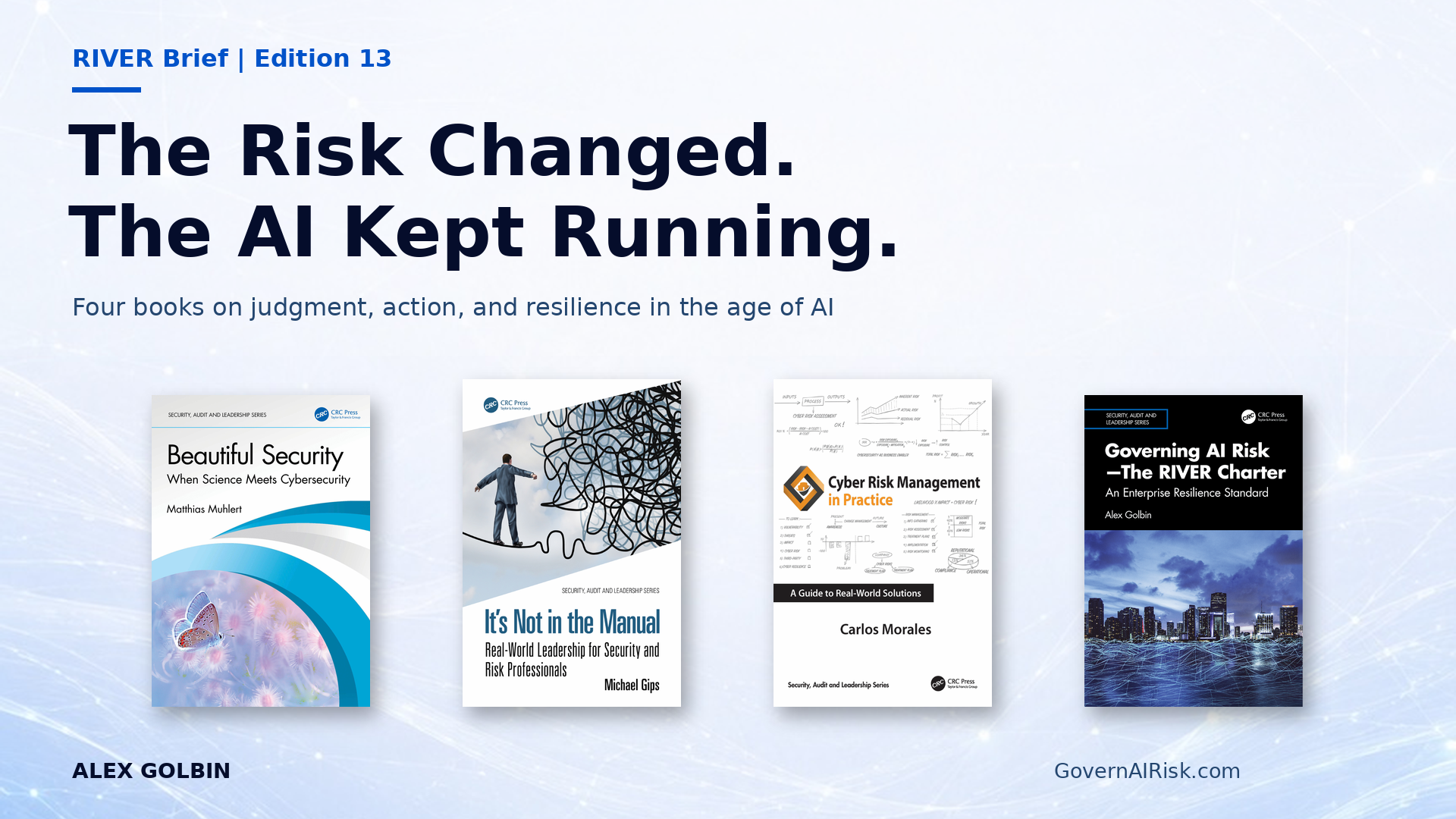
Four books on judgment, action, and resilience in the age of AI.
Consider a hypothetical customer-service workflow.
An AI assistant was approved to read tickets and recommend adjustments. A person reviewed its recommendations before anything reached a customer’s account.
Months later, a workflow integration gives the assistant permission to initiate certain adjustments itself. A new data feed helps it classify requests. The service is faster. The business sees a useful improvement.
A review identifies the expanded authority and a gap in validation of the new feed. The concern reaches the accountable people. The risk assessment is updated. A follow-up is recorded, but no interim operating decision is assigned to an owner.
The assistant keeps running.
That does not automatically mean it should have been stopped. Continuing may be justified. Restricting one permission may be enough. The new feed may need additional validation before it supports an automated action.
Meanwhile, an incorrect adjustment could reach a customer’s account before the review is complete.
An updated assessment can coexist with an unchanged operation. What matters is whether that continuation is a decision someone owns.
Putting Governing AI Risk—The RIVER Charter alongside three other books from the Security, Audit and Leadership Series brings that distinction into focus: Matthias Muhlert’s Beautiful Security, Michael Gips’s It’s Not in the Manual, and Carlos M.’s Cyber Risk Management in Practice.
These books address different problems. Read together, they offer complementary ways to examine what happens between new evidence and an effective operating response.
1. A local change can reshape the wider risk

Muhlert draws on mathematics, physics, psychology, and biology to help us understand and rethink cybersecurity. His scientific perspectives illuminate uncertainty, human behavior, and cascading risks, while informing adaptive, resilient defenses.
For this workflow, the strongest connection is interdependence: a change within a connected system can reshape risk beyond the component being changed.
The assistant’s original arrangement separated recommendations from financial action through human review. Adding execution permissions and a new data feed changes those relationships. An error or manipulated input may now have a more direct route to a customer’s account.
That is a change in how the system behaves, even if each integration appears modest on its own. Its significance depends on what becomes connected, how effects can propagate, and which defenses still hold.
Human behavior belongs in that picture too. Retaining a review step offers limited protection if reviewers lack the context or capacity to challenge recommendations.
Applied here, Muhlert’s broader scientific lens invites us to reconsider the assumptions and defenses built around the workflow as its relationships change. A small change need not produce a cascade, but its local size is an unreliable guide to its wider consequences.
What changed in the system’s relationships—and do our assumptions and defenses still fit?
2. Leaders have to decide what the evidence warrants

Gips examines the human work of leadership under uncertainty. His discussion of cognitive dissonance is relevant here: when new information challenges an existing belief, people can revise that belief or rationalize the conflict.
His treatment of adaptive leadership also distinguishes problems with established solutions from challenges requiring learning, experimentation, and engagement.
That matters when a working system becomes harder to justify.
The assistant is helping customers. Teams have invested in it. Reinstating manual review may create a backlog. A complete shutdown could introduce operational problems of its own. None of those considerations makes the new evidence disappear. They make the decision consequential.
Leadership requires judging the evidence alongside the costs of action and inaction. Sometimes that means holding course with explicit acceptance, closer monitoring, and a defined review point. Sometimes it means limiting the workflow while a specific uncertainty is resolved.
While the review continues, someone still owns the operating posture: which actions remain enabled, which need human approval, and when the decision returns for review. A meeting scheduled for next month does not answer what the system may do tomorrow.

In Governing AI Risk, Risk Debt describes the compounding liability from speed-over-validation choices. In this scenario, it could arise if the enterprise keeps taking the benefit of expanded automation while deferring the validation needed to support it.
A recorded risk acceptance and a deferred decision are not interchangeable. A useful test is whether someone can explain what is being accepted, on what evidence, for how long, and under whose authority.
3. The response has to reach the operation

Morales supplies a practical connection between assessment and execution. His risk-management sequence covers context, assessment, treatment, communication and implementation, and monitoring.
He treats monitoring as an ongoing feedback process: changes in the environment inform reassessment and adjustments to treatment, while control effectiveness is checked against expectations.
This is already part of sound risk management. The problem arises when organizations perform the assessment but fail to complete the response it warrants.
For our assistant, a higher risk rating does not itself change a permission. Recording a follow-up does not validate the feed. A committee discussion does not assign an engineer to modify the workflow or a business owner to accept the resulting service impact.
An executable response identifies the action, the owner, the authority, the delivery date, and the evidence needed to close it. The decision also needs a review point if the intended change cannot be implemented promptly.
Suppose the decision is to retain automated classification but restore human approval for financial adjustments until the feed has been validated. Classification and recommendations can continue, preserving useful capacity while consequential actions receive additional scrutiny. The business owner needs to establish whether the review team can handle the volume; the technology owner needs to implement the permission change. Together, they need a defined point for reviewing the arrangement and deciding whether automation can resume.
The decision becomes meaningful through the operating behavior it produces.
4. Completion needs evidence
The test is whether the chosen treatment achieved its intended result. Some exposure may remain and require explicit acceptance and monitoring.
A closed action is a claim about completion. An effective response needs evidence about the operation.
If the assistant’s permissions were restricted, can it still reach the prohibited action through another integration? If human approval was restored, does the reviewer have the information and time to challenge a recommendation? If management chose to continue, are the monitoring conditions and intervention authority actually in place?
Return to the assistant. Test transactions should verify that human approval is enforced across the identified execution paths, including other integrations. A sample of reviewed cases can help assess whether people are meaningfully challenging recommendations. Monitoring can then show whether the arrangement remains workable. None of those checks proves every risk has disappeared; each supports a specific part of the operating decision.
For me, this is where the four perspectives connect. Scientific perspectives help us understand how changes within the system reshape risk. Leadership turns uncertainty into a decision. Risk management makes the response executable and reviewable. The resilience question is whether that process keeps deferred validation from becoming embedded fragility.
The books do not advance an identical argument. This connection is my synthesis of their different contributions.
5. Holding course can be the right answer
There is a serious objection to this approach: if every signal reopens an approval, governance can consume the value it is supposed to protect.
Signals can be weak or misleading. Intervention can disrupt a service. Frequent changes can create instability, while repeated escalations teach teams to disregard the process.
The answer is proportionate reconsideration.
At approval, identify the changes that would materially weaken the basis for the decision. A move from advice to execution is different from a routine update within a tested operating boundary. A new dependency supporting a consequential action deserves different attention from a cosmetic interface change.
When a meaningful condition changes, the response should fit the evidence. Narrowing permissions, testing a feed, limiting transaction values, or increasing review may preserve much of the benefit while addressing the concern.
Continuing can also be justified. But it should be a decision someone can explain and revisit, with evidence and ownership attached.
Three questions for one live AI workflow
Choose a workflow already operating in your organization.
1. What has changed since the decision was made? Consider capability, data, permissions, dependencies, scale, delegated authority, and the effectiveness of human oversight.
2. What operating decision does that change justify? Name who can decide, who can implement the response, and the temporary operating conditions while uncertainty remains. Set a date for reconsideration.
3. What would show that the decision is working? Define the evidence, the review point, and the conditions that would require another look.
In the earlier multi-book RIVER Brief, Governance Fails in the Handoffs, I examined what happens when meaning, evidence, and accountability fail to travel between functions.
Here, the evidence arrives. The question is what the organization does with it.
When the risk changes in your organization, what makes the operating decision change—or makes continuing a decision you can defend?
Special thanks to Taylor & Francis Group, Gabriella Williams and Dan Swanson for supporting publishing these books.
Books featured in this RIVER Brief
• Beautiful Security: When Science Meets Cybersecurity — Matthias Muhlert
• It’s Not in the Manual: Real-World Leadership for Security and Risk Professionals — Michael Gips
• Cyber Risk Management in Practice: A Guide to Real-World Solutions — Carlos Morales
• Governing AI Risk—The RIVER Charter: An Enterprise Resilience Standard — Alex Golbin
